Supplies are eating your margin — and nobody's tracking it
The average dental practice in the United States spends between $50,000 and $120,000 per year on consumables: gloves, burs, anesthetics, impression materials, disposable instruments. That's 6–8% of revenue — the second-largest expense line after staff. And most practices buy from 4–7 different suppliers, manually, through phone calls and PDF catalogs, with no unified tracking system.
The result is predictable: practices overpay an average of 20%+ compared to market price. They don't know that Patterson Dental is 18% cheaper on a specific item than the Benco rep they've been loyal to for ten years. They don't catch when the assistant double-orders the same bur because there's no inventory visibility. They can't consolidate volumes — and never get volume discounts.
That's the gap Torch Dental stepped into.
Product and Market
Torch Dental is a supply management platform for dental practices. Founded in New York in 2019, the company was working with more than 3,000 clinics across the US by 2024.
The US dental supply market is valued at $13–15B per year. Globally, around $40B. It's a fragmented, conservative market: three major distributors — Henry Schein, Patterson Dental, and Benco — control roughly 70% of wholesale sales, but their technology stack is stuck in 2005. None of them offer real-time price comparison, smart analytics, or automated ordering.
TAM is the full procurement market. SAM is practices willing to pay for a management platform. With 3,000 clinic SOM and an average contract of $6,000–12,000 per year, the company's ARR is $18–36M.
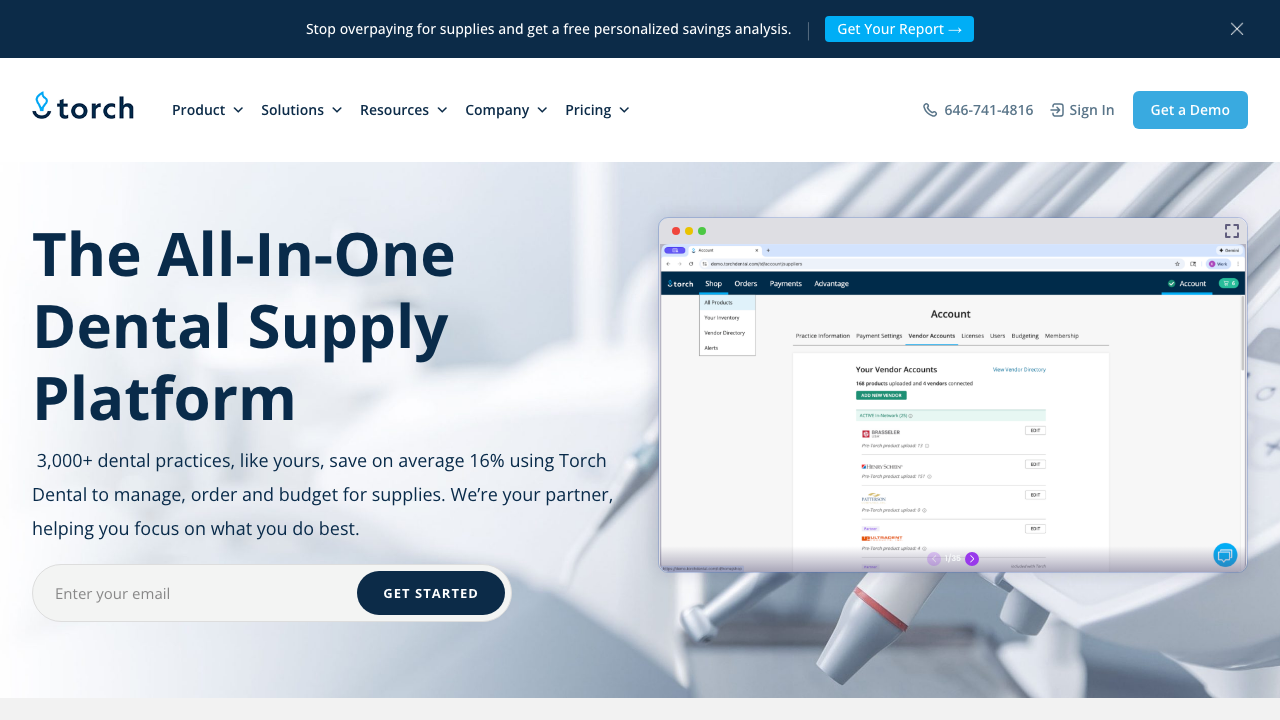
Torch Dental's homepage: the platform positions itself as an all-in-one for dental supply management.
The Disruption Point: Where Offline Meets AI
Traditional procurement in dentistry looks like this: the front desk notices gloves are running low, calls the Patterson rep, the rep emails a quote, the dentist approves, the order gets placed manually. No price comparison. No inventory tracking. Next month: repeat.
Torch Dental layers three levels of automation on top of this chaos.
Layer 1 — Supplier aggregation. The platform connects to APIs for Benco, Patterson, Henry Schein, Darby, and dozens of niche suppliers. The practice sees a single catalog with live prices from all vendors simultaneously. One-click purchasing — no calls, no PDFs.
Layer 2 — AI recommendations. The system analyzes the practice's purchase history, identifies consumption patterns, predicts when specific materials will run out, and suggests an optimized order proactively. The algorithm also flags "expensive habits" — cases where the practice is buying branded items when a quality equivalent costs less.
Layer 3 — Volume consolidation. Torch Dental aggregates orders across all its clients and negotiates wholesale discounts with suppliers. An independent single-dentist practice gets the pricing power of a large group — without giving up independence.
This is offline x online in its cleanest form: physical goods, physical clinic, physical patients — with an AI layer that digitizes procurement and flips it from reactive to proactive.
Declared results: 64% reduction in time spent on ordering, 16%+ savings on supply costs. For a practice with $1M in revenue and a $70K supply budget, that's $11,200 in direct annual savings.
Business Model and Unit Economics
Torch Dental earns on multiple streams simultaneously.
Primary: SaaS subscription. The practice pays a monthly fee for platform access. Exact pricing isn't public — the model is consultative, with demos and custom proposals. Based on industry comparables and indirect data: $300–800/month for a solo practice, $1,000–3,000/month for a group. Annual ARR per client: $3,600–36,000.
Secondary: transaction commission. Torch takes a percentage of purchasing volume flowing through the platform. This makes the model look like a marketplace with a subscription — two revenue streams from one client.
Hidden: data. 3,000+ clinics generate a unique dataset on dental procurement behavior in the US. This is a strategic asset whose monetization hasn't been disclosed.
The unit economics are attractive for several reasons. A dental clinic is an exceptionally sticky customer: switching procurement tools is painful, requires staff retraining, and means migrating purchase history. Churn in this segment doesn't exceed 5–8% per year for successful platforms. LTV/CAC exceeds 5x with the right sales model.
CAC is moderate: sales happen through direct outbound to practice owners and through dental associations — not expensive performance marketing. A practice makes decisions slowly (2–4 months), but then stays for years.
How to Enter This Market
Torch Dental raised $20M in a Series A in November 2022. Total funding is approximately $31M including seed and bridge rounds. Investors include Spark Capital and strategic angels from the dental industry.
Direct acquisition of Torch as a solo founder isn't realistic — it's a venture-backed company. But the model is reproducible in three formats:
1. Vertical SaaS for a specific niche. The same procurement problem exists in veterinary clinics ($10B market), medical offices, pharmacy chains, restaurants, beauty studios. Minimum MVP: price aggregator across 5–7 suppliers plus smart ordering.
2. Buy an independent clinic and implement the system. A solo dental practice sells for 0.5–1.5x EBITDA. After implementing Torch or an equivalent, supply savings of $8–15K per year go directly into the new owner's pocket.
3. Roll-up clinics through technology advantage. Consolidating 5–10 clinics in one area creates purchasing volume for supplier negotiations. The pricing advantage becomes an argument when buying the next clinic.
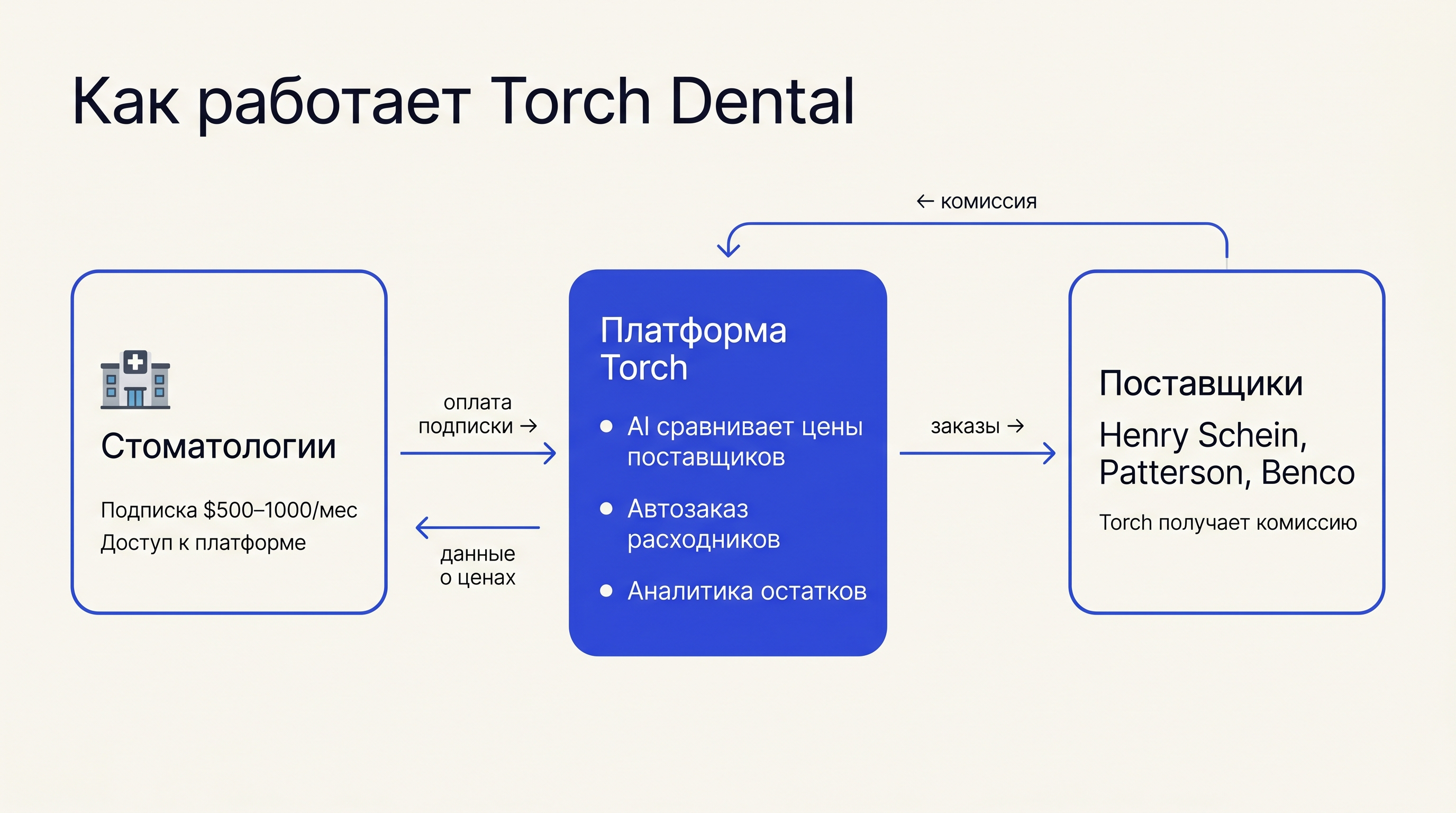
How the two-sided monetization works: subscription revenue from clinics, commission revenue from suppliers.
Competitive Moat
Torch Dental builds several layers of protection.
Data as moat. Every order placed through the platform trains the recommendation algorithm. More clinics means more accurate consumption forecasts. A new competitor can't copy this dataset by cloning the code.
Integrations as switching costs. The platform integrates with practice management systems — Dentrix, Eaglesoft, OpenDental. Once integrated, switching means losing order history and breaking workflows. High switching cost.
Supplier-side network effect. More clinics buying through Torch means better discounts extracted from Patterson and Benco. Better discounts make the platform more attractive for the next clinic. Classic flywheel.
Savings as built-in word-of-mouth. A clinic that saved $11K tells colleagues. The dental community is tight — strong word-of-mouth through associations and conferences.
Direct competitors — Vyne Dental, Dentsply Sirona's digital tools — don't offer real-time price comparison. Henry Schein is attempting to build its own marketplace, but the conflict of interest (it's also the seller) limits the platform's credibility as a neutral aggregator.
How This Works in the US
This playbook is already playing out in the US dental market — Torch itself is the proof. But it's worth mapping what the opportunity looks like for a founder entering this space today.
Competitive landscape: Torch's direct competitors include Vyne Dental and Sowingo. Henry Schein's marketplace attempt is compromised by the conflict-of-interest problem — the distributor cannot credibly be the neutral platform. This gives an independent aggregator a structural advantage.
Analogous plays in adjacent verticals: AutoLeap and Shop-Ware are running similar procurement-and-ops plays in auto repair. Vetcove built the identical model for veterinary supplies and processed $1B+ in purchasing volume. These precedents validate that the category works — the question is which niche you pick.
Realistic US launch path for a solo founder:
- Scrape or manually build a price comparison layer across the three major dental distributors. This alone is worth money to practice managers.
- Charge $299–499/month per practice. Find 20 paying clinics through dental Facebook groups, the ADA's network, and cold outbound via LinkedIn.
- At 20 clinics you have enough data to start surfacing cross-practice benchmarks — the first version of the data moat.
- Year 2: add the volume consolidation layer and negotiate your first supplier discount. This is when unit economics start compounding.
Sales cycle reality: dental practice owners are conservative and slow to decide (2–4 months is normal). But churn is 5–8% once they're in. The patience required on the front end is the moat on the back end.
Budget estimate: $15–40K to build a functional MVP with supplier integrations, basic analytics, and Stripe billing. First 20 clients at $400/month = $8K MRR and $96K ARR — enough to validate the model before hiring anyone.
Verdict
Torch Dental proves that the most boring offline process — buying supplies — becomes a venture-scale business when you add AI aggregation, price transparency, and volume-based network effects.
The dental market is just one niche. The pattern — fragmented buyers, multiple disjointed suppliers, no price visibility, reactive purchasing — exists in dozens of verticals. Find yours.