The Setup
Alex Jekowski left college in his sophomore year. At 23, he sold his first startup and started hunting for the next idea. He worked through a list of unglamorous industries until he stumbled onto the Coin Laundry Association. What he found shocked him.
There are more than 90,000 laundromats, dry cleaners, and alterations shops in the United States. Most of them still run on coins. Owners track revenue in Excel — if they track it at all. The closest thing to an analytics tool is a bag of quarters counted by hand at the end of a shift.
A $60 billion industry. Near-zero digitization. In 2021, Jekowski founded Cents.
By 2026, the company had raised a $140M Series C from Sumeru Equity Partners — the largest investment in laundry-tech history — serving 4,500+ locations and processing $1B in payments per year. Retention: 99%. Not a typo.
How It Works
Vertical SaaS: building an OS, not a tool
Cents isn't "software for laundromats." It's a full operating system for an industry everyone called undigitizable. The product stacks several modules, each closing a distinct layer of pain.
Cents OS is the core business management layer: POS, online ordering, employee scheduling, reporting. It's the entry point — an owner gets a single screen showing everything from machine loads to daily revenue.
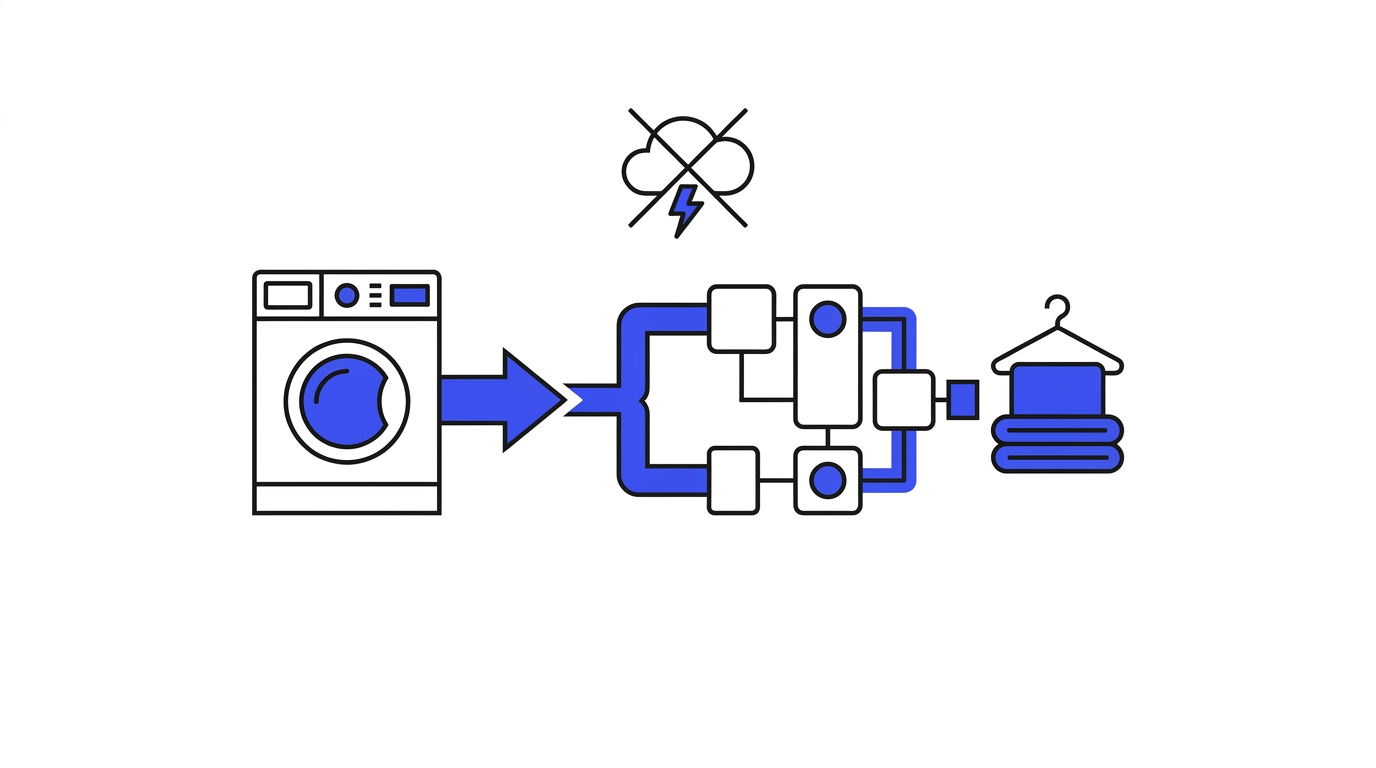
Cents Connect is where the real leverage kicks in. A physical IoT device that wires into any brand of washer or dryer. The machine becomes a connected asset: the owner sees in real time which units are running, which are idle, which need maintenance. Customers pay from their phone — no coins, no card readers required.
Cents Dispatch is the logistics layer for pickup and delivery. The laundromat adds a new sales channel: order dirty laundry picked up, get clean clothes delivered. Average ticket for P&D: $79.81 versus $44.19 for drop-off — an 80% premium for convenience.
Cents Accelerate is built-in marketing: email, SMS, review management. Tools that previously only existed in chains with a dedicated marketing hire.
Cents Assist is an AI receptionist that handles 80–100% of inbound customer questions. "Where's my order?" "What are your hours?" "How much for a comforter?" — none of that reaches a human anymore.
Cents Capital offers low-rate lending to operators. When you own the payment rails, you understand the customer's financials better than any bank.
IoT as the retention mechanism
The key insight at Cents: physical hardware creates switching costs that pure SaaS cannot match. Once you've installed Cents Connect across 20 machines, you're embedded in the ecosystem — not because the terms are punitive, but because your machine data, customer history, and order records all live inside the system. Leaving means starting from scratch.
This is exactly how Toast dominates restaurants: POS + terminals + online ordering create an ecosystem that's expensive to leave.
Dynamic pricing — yield management for a laundromat owner in Wisconsin
One feature that looks obvious in hindsight but was genuinely new for this industry: dynamic pricing. Peak times (Saturday mornings, typically) see prices automatically rise; dead slots fall. The result is smoother utilization and higher average ticket.
A laundromat owner in Wisconsin isn't thinking about yield management — it's too complex. Cents thinks about it for them.
Memberships as a new revenue stream
Cents Memberships may be the platform's most structurally important feature. A laundromat creates a plan — say, "8 washes per month for $49." The customer pays upfront; the owner gets predictable revenue. This isn't just a feature — it's a business model shift for an entire industry.
56% of American laundromats still accept coins as their primary payment method. Those that switch to digital payments through Cents see average ticket climb from $31 (cash) to $49 (card) — a 58% increase without changing prices.
The Numbers
| Metric | Value |
|---|---|
| US Market Size | $60B |
| Retail locations in the US | 90,000+ |
| Locations on platform | 4,500+ |
| Market share | ~1 in 12 laundromats |
| Annual payment volume | $1B |
| Customer retention | 99% |
| Total funding | $217M+ |
| P&D vs. drop-off average ticket | $79.81 vs. $44.19 (+80%) |
| Card vs. cash average ticket | $49.41 vs. $31.12 (+58%) |
| AI Assist coverage | 80–100% of inquiries |
Why It Works
1. A massive market with no real competition
When Jekowski started, he had essentially no serious competitors. A $60B market, almost no digitization. That's rare in 2021 — most "analog" industries already have at least one credible software player by then. The laundry business was a genuine terra incognita.
Why? Because it's an ugly business. Nobody in Silicon Valley dreams of building SaaS for laundromats. It's "boring," it's "too local," it's "too small-scale." That's exactly why the window was open.
2. Data network effects
The more locations on Cents, the better the algorithms — dynamic pricing, predictive analytics, cross-location benchmarks. An independent laundromat owner has no idea whether their conversion rate is good. Cents knows, because it's watching 4,500 shops.
The annual "Into the Fold" industry report isn't just marketing. It's Cents establishing itself as the only source of laundry industry data. Loyalty through expertise.
3. Multi-layer monetization
Cents earns on at least four streams:
- SaaS subscription (software access to the OS)
- Hardware margin (Cents Connect devices)
- Payment processing fees (a cut of each transaction)
- Capital (interest income from lending)
This is what the VC world calls "embedded finance." Toast ran the same playbook in restaurants and went public at a $10B+ market cap.
4. What 99% retention actually means
Vertical SaaS with hardware creates maximum switching cost. But Cents argues they keep customers through genuine value, not a trap: operators see revenue grow, operational load drop, and new sales channels open. When a product directly impacts P&L, there's no reason to leave.
How to Apply This as a Solo Founder
Cents isn't a story about "build SaaS and raise $140M." It's a story about a principle that works at any scale.
Principle 1: Look for ugly markets
The best opportunities are where there's no hype. Restaurants, barbershops, auto repair shops, alterations, tutoring centers, small manufacturers — every one of these has pain points that no decent software has ever addressed.
The diagnostic question: "Does anyone in this industry still use Excel or paper for something critical?" If yes, there's a market.
Principle 2: Start with one pain point, then expand
Cents launched with a basic POS. Only after proving product-market fit did they add IoT, then delivery, then marketing, then lending. A solo founder cannot build an "operating system" from day one — but can solve one specific pain, then expand.
Principle 3: Physical hardware as lock-in (even if you don't make hardware)
A hardware component doesn't mean you manufacture anything. Cents connects to existing machines through its module. Similarly, a solo founder can create physical attachment through integration: data onboarding, equipment setup, staff training. The deeper you're embedded in the customer's operations, the higher the retention.
Principle 4: Data as a product
Once you have multiple clients in the same niche, you have aggregated benchmarks nobody else has. Publish reports, share industry data — this is simultaneously marketing and a retention tool.
Practical first steps
If you want to try this model solo:
- Pick a niche with 10,000+ small businesses in one country
- Talk to 20 owners, find one recurring pain
- Build the minimum tool — spreadsheet + script + integration
- Charge $99–299/month, find your first 10 paying customers
- Only expand after you find a model with 90%+ retention
Jekowski knew nothing about laundromats at 21. He just found a market where nobody was looking.
How This Works in the US
This model is most obviously applicable right now in the US — which is, after all, where Cents operates. But the playbook applies broadly to any fragmented, cash-heavy, tech-resistant vertical.
Direct analogs: Auto repair (AutoLeap, Shop-Ware are building similar vertical OS plays), veterinary clinics, beauty salons (Vagaro, Boulevard), self-storage (Storable). Every one of these has a version of the same problem: fragmented ownership, paper-first operations, no data layer.
US launch channels for a vertical SaaS in a trade industry: trade associations (there's one for everything), regional owner Facebook groups, industry publications, and BizBuySell-listed owners who are already thinking about the business professionally. Reddit communities like r/sweatystartup and r/Entrepreneur surface real operators who are vocal about what's broken in their workflow.
Realistic solo entry budget: $10–30K to build a working MVP with Stripe integration, basic analytics, and one core workflow automated. First 10 customers at $200/month each = $2K MRR — enough to validate before scaling. The hardware layer (if you go there) comes later, once you've proven the software retention.
The window that Jekowski found in 2021 still exists in dozens of industries. The pattern repeats.