The Setup: the most expensive asset nobody has data on
Imagine you have 500 trucks. Each worth $150,000. That's $75 million in rolling iron crossing the country. Question: do you know right now where each one is?
Most logistics companies would answer honestly: "roughly." They'd call the dispatcher. The dispatcher would call the driver. The driver would say: "somewhere on I-80 between Salt Lake City and Reno." That's it. No real-time position, no telematics, no visibility into how the driver is behaving, what's happening with the engine, whether they're speeding.
This isn't hypothetical. It's the reality of the majority of transportation and logistics companies worldwide — including those running thousands of vehicles.
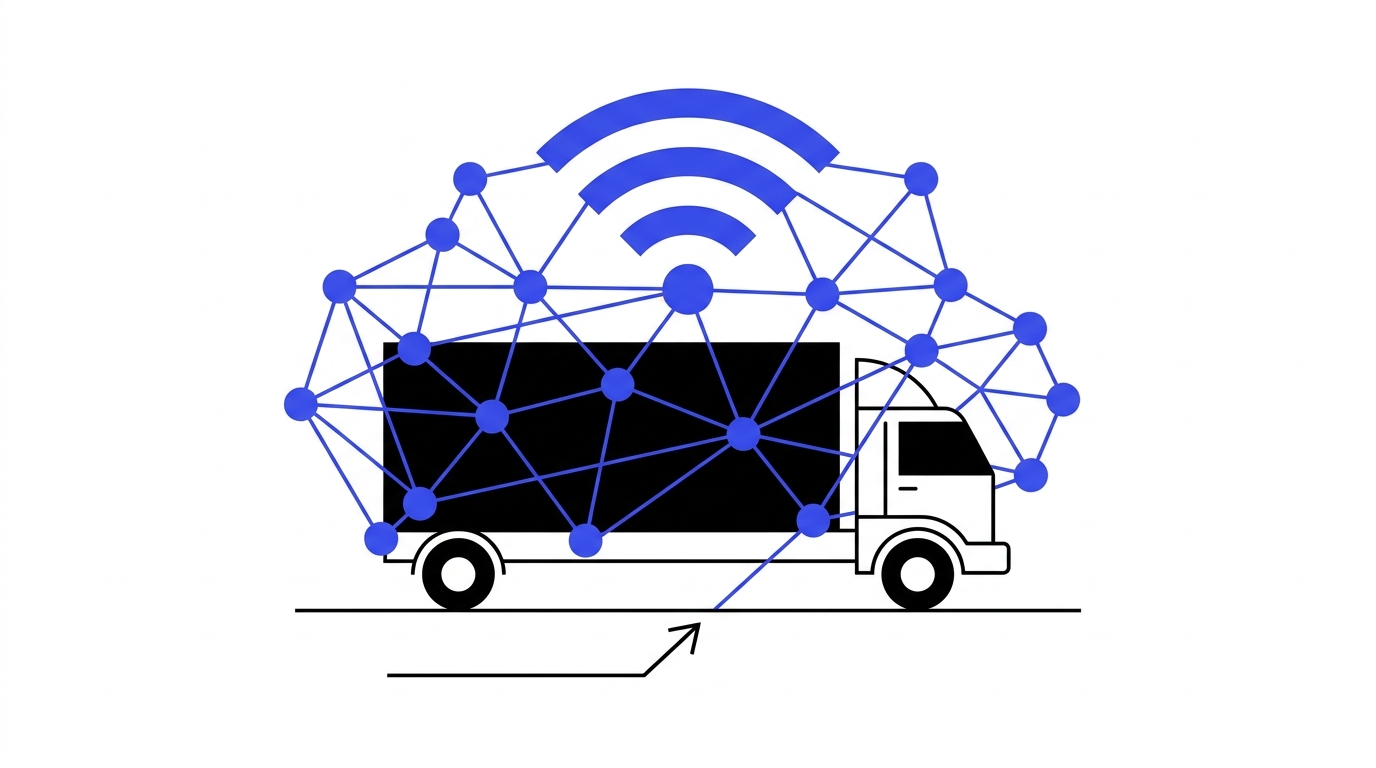
Samsara did a simple thing: they plugged a small IoT device into the OBD-II port of every truck, connected it to the cloud, and started selling the data. Engine temperature, speed, hard braking, GPS location, fuel consumption, hours of service — all of it in real time, on a dashboard, with AI analytics on top.
Founded in 2015. IPO'd on NYSE in 2021 at an $11B valuation. By 2025: $25B market cap. ARR crossed $1.1B. One of the rare examples of an entirely offline industry — trucking, utilities, construction — transformed into a SaaS company.
Product and Market
Samsara positions itself as a "Connected Operations Cloud" — a platform that bridges physical operations with a digital data layer. The marketing language is vague; the product stack is concrete.
Hardware:
- Vehicle Gateway (VG34) — an OBD-II device that plugs into the diagnostic port in 30 seconds. Transmits vehicle telematics, GPS, engine data
- CM32 / CM34 — a dashcam with onboard AI video processing. Watches the road and the driver simultaneously. Detects distraction, drowsiness, phone use, following distance violations
- IG21 — an industrial IoT gateway for non-transportation assets: generators, excavators, pump stations. Tracks vibration, temperature, runtime hours
- AG26 — a battery-powered trailer and asset tracker. Transmits location every few minutes, no vehicle power required
Software layer:
Fleet Management — a real-time map with routes, stops, ETA. The dispatcher sees all vehicles, status of each, route deviations.
Driver Safety — the core AI product. Computer vision models analyze dashcam video, flag dangerous driving behavior, and automatically generate coaching sessions for drivers. Not just a flag — built-in training content with examples from that specific driver's footage.
Equipment Monitoring — industrial IoT. Predictive maintenance: the algorithm forecasts equipment failure days in advance based on vibration and temperature anomalies. Instead of "it breaks, then you fix it" — "the system says: within 72 hours, 87% probability the water pump fails."
Workflows — digital checklists for drivers and operators. Pre-trip inspections, freight pickup/delivery, job site checks. Phone and camera instead of paper.
Hours of Service — automatic drive-time tracking for regulatory compliance. In the US, this is the ELD mandate — federal law since 2019.
The market. Samsara operates across several verticals:
- Transportation and logistics (~40% of customer base) — carriers, couriers, distribution centers
- Construction — excavators, cranes, dump trucks
- Utilities — water, energy, waste management
- Oil and gas — field operations, pipeline equipment
- Food and retail — refrigerated supply chains
The company estimates TAM at $55B in the US alone. Globally: $140B+. Not a fantasy: take the number of trucks in the world (~400 million), multiply by $2,000–5,000 annual subscription.
The Disruption Point: Why Samsara Isn't Just "Another GPS"
Fleet management as a market existed before Samsara. Legacy players: Verizon Connect, Geotab, Trimble, FleetComplete. All offered basic GPS tracking. So why is Samsara a $25B company instead of just another vendor in that space?
Three reasons.
First: vertical integration of hardware and platform. The old guard is either hardware without real software, or data aggregators without their own devices. Samsara built both. This means:
- Devices update over the air — no tech dispatch required
- Data flows from hardware directly to the platform with no intermediaries
- When AI video analysis arrived, it integrated into already-installed cameras — no hardware replacement needed
Second: AI on top of the data. GPS tells you "where." Samsara tells you "why" and "what's coming." Example: out of 50 drivers, the algorithm identifies five with a pattern of hard braking plus speeding at specific times of day. This isn't just data — it's a predictive signal: these drivers are statistically likely to be involved in an accident next quarter. The fleet manager and the insurer both care about this.
The dashcam AI is its own story. The camera watches the road and the driver's face simultaneously. It detects:
- Distraction (eyes off road for more than 2 seconds)
- Fatigue (heavy eyelids, yawning)
- Phone use (posture, hand movements)
- Following distance violations
- Running red lights
This happens on the camera chip itself (edge inference), with no video sent to the cloud. Only the event plus a 10-second clip. An immediate audio alert to the driver. The clip enters the manager's review queue.
Accident rates for Samsara customers fall 30–50% — documented in public case studies. For a fleet of 500 trucks, one serious accident costs $200,000–$2,000,000 in damages, litigation, downtime, and insurance. Preventing five accidents per year is worth $1–10M in savings against a $100–200K annual subscription. The ROI is obvious.
Third: platform openness. Samsara opened its API and built an integration ecosystem: SAP, Oracle, Salesforce, QuickBooks, McLeod, Mercury Gate (the major TMS platforms). This means IoT device data flows automatically into the customer's ERP. Driver delivers freight — SAP automatically closes the order — invoice generated. Zero manual entry.
This is the disruption: Samsara turned the truck from a physical asset into a connected endpoint. Every vehicle became a data source that improves the economics of the business. Less fuel burned (predictive routing, less idling), fewer accidents (AI driver coaching), fewer unplanned repairs (predictive maintenance), fewer thefts (real-time geofencing).
Business Model and Unit Economics
Hardware + SaaS subscription. Important: Samsara doesn't sell hardware as a standalone product. The device is sold at cost or slightly above — the money is made on the subscription.
Pricing (public data):
- Fleet Management (basic tracking) — from $27/month per vehicle
- Driver Safety (cameras + AI) — $20–40/month per camera
- Equipment Monitoring — $20–35/month per asset
- Compliance (ELD, HOS) — $15–25/month per driver
Enterprise customers get volume discounts. Contracts run 3–5 years with automatic renewal.
Metrics (FY2025, most recent public report):
- ARR: $1.1B (+33% YoY)
- Customers with ARR $100K+: 2,026 companies
- Customers with ARR $1M+: 179 companies
- Net Revenue Retention: 115% — meaning existing customers pay 15% more year-over-year
- Gross Margin: ~75%
- Connected assets: more than 3 million vehicles and equipment units
NRR 115% is the key metric. Every cohort dollar becomes $1.15 the next year without adding new customers. Clients buy more devices, expand licenses, add new vehicle types. Expansion revenue is Samsara's primary engine.
Unit economics for a mid-size customer. A trucking company with 200 vehicles:
- 200 Fleet Gateways x $27/month = $5,400/month
- 200 Dashcams x $35/month = $7,000/month
- 200 ELD compliance x $20/month = $4,000/month
- Total: ~$16,400/month = $196,800/year
For Samsara, that's one customer at $197K ARR. CAC for this customer: $50–100K (complex enterprise sales cycle, pilot, integration). LTV at 5–7% annual churn: $2–4M. LTV/CAC: 20–40x.
This explains why the company IPO'd at a loss (growth opex) but Wall Street valued it at tens-of-ARR: when retention is 115% and LTV/CAC is 30x, every new revenue dollar is a machine that turns $1 into $30.
How to Enter This Space
Two levels.
Level 1: Acquire a Samsara customer. Buy a transportation or logistics business already running connected fleet technology. In the US this is called a "technology-enabled acquisition": you pay a premium above the standard multiple because the business is already digitized. Driver, route, and asset data becomes an operational lever for post-acquisition optimization.
Level 2: Build a vertical analog. In the US, the fleet management market is mature but the AI safety layer is still being defined. The opportunity is in building focused, vertical products that serve segments too small for Samsara's enterprise sales motion.
Defensible niches within the US:
- Refrigerated supply chains — food, pharma, and seafood logistics where temperature violations mean product write-offs. IoT temperature monitoring with AI anomaly detection is a focused, high-value vertical.
- Construction equipment — unplanned excavator downtime costs thousands per day. Predictive maintenance for CAT and Komatsu fleets is a real gap.
- Last-mile delivery fleets — regional carriers running 50–200 vehicles often can't afford Samsara's enterprise sales cycle. A focused, self-serve product at $20/vehicle/month could own this segment.
Competitive Moat
Samsara's moat is one of the most durable in enterprise SaaS. Here's why.
1. Physical installation. Devices are already in 3 million vehicles and equipment units. Physically swapping out a device means field tech dispatch, equipment downtime, driver retraining, TMS reintegration. The switching cost for a 500-truck fleet is 6–12 months of headaches and $100–300K in hidden costs. Churn is 5–7%, not the 20% typical of pure SaaS.
2. Historical data. After two years, a customer has 15 million kilometers, 300,000 trips, and driver behavioral patterns inside the Samsara system. Moving to a competitor means losing this analytical history. AI models are trained on that specific fleet's specific data.
3. Integration graph. 200+ integrations with ERP, TMS, insurance, and tax systems. Each integration represents hours of customer IT work. A competitor has to rebuild the entire graph.
4. Regulatory anchor. In the US, the ELD mandate is federal law. Every commercial truck must have a certified Electronic Logging Device. Samsara is certified. The government is effectively a sales channel: customers have to buy something like Samsara by law.
5. Data network effects. 3 million connected assets means 3 million training data sources for AI models. Driver Safety AI trained on 3 million vehicles is better than one trained on 300,000. Data improves the product, better product attracts more customers, more customers generate more data. Classic data flywheel.
The main vulnerability. Hardware dependency: if a competitor builds a better OBD device with cheaper cellular connectivity, Samsara has to upgrade hardware at millions of customer vehicles — expensive. Also: new trucks from Tesla Semi, Rivian, Daimler, and BYD ship with embedded telematics from the factory. Samsara must integrate with those platforms rather than compete with them.
Verdict
Samsara is the textbook example of how a technology layer on top of a physical business creates a company of an entirely different class. Not just "automation" — but turning every truck into a connected endpoint that generates data, trains AI models, and improves the customer's economics.
Three things make this model exceptional:
First: regulatory tailwind. Governments worldwide are mandating digital monitoring of commercial vehicles — the state as a sales channel. You don't have to convince the customer they need the product when the law requires it.
Second: NRR 115%. This isn't ordinary SaaS. The customer doesn't just renew — they expand. They add cameras, connect new vehicles, extend to other equipment types. This is an expansion engine that runs without a dedicated sales team.
Third: physical lock-in. Devices are installed in 3 million vehicles. This isn't a password you change in five minutes. It's physical hardware embedded in the operational process of a business.
Offline operations are the largest untapped data center in the world. It just doesn't have IoT in it yet.