Every plumber running three crews knows the real problem isn't fixing the pipe. It's remembering to send the invoice, not losing the job request, and not showing up at the wrong address. Sam Pillar and Forrest Zeisler built a $167.5 million business on exactly that chaos.
What They Do
Jobber is a cloud platform for small and mid-size field service businesses: plumbers, electricians, landscapers, cleaners, HVAC technicians, and 50+ other trades. The product covers the full cycle from the first customer call through to collected payment.
At the core are four modules: a CRM with full client and property history, crew scheduling with route optimization, invoicing with automated payment reminders, and integrated online payment collection. Since August 2025, the platform has included an AI receptionist -- a virtual assistant that answers calls and texts 24/7, recognizes returning customers by phone number, and creates job requests in the CRM automatically. In its first months it handled over 200,000 conversations.
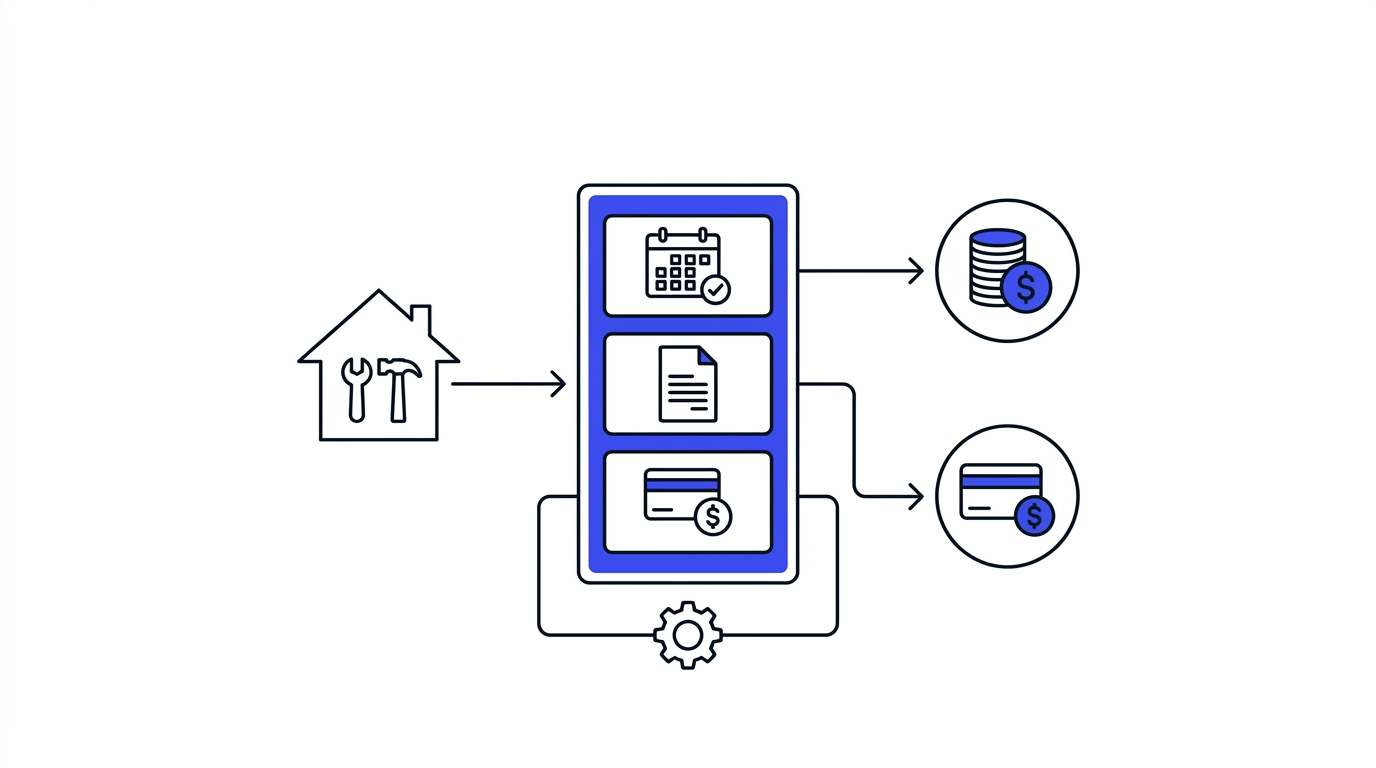
Where the money comes from: subscriptions ranging from $29 to $699/month, plus a processing fee on every payment (2.9% + $0.30). Online payments already account for over 50% of all transactions on the platform -- a second revenue line growing faster than subscriptions.
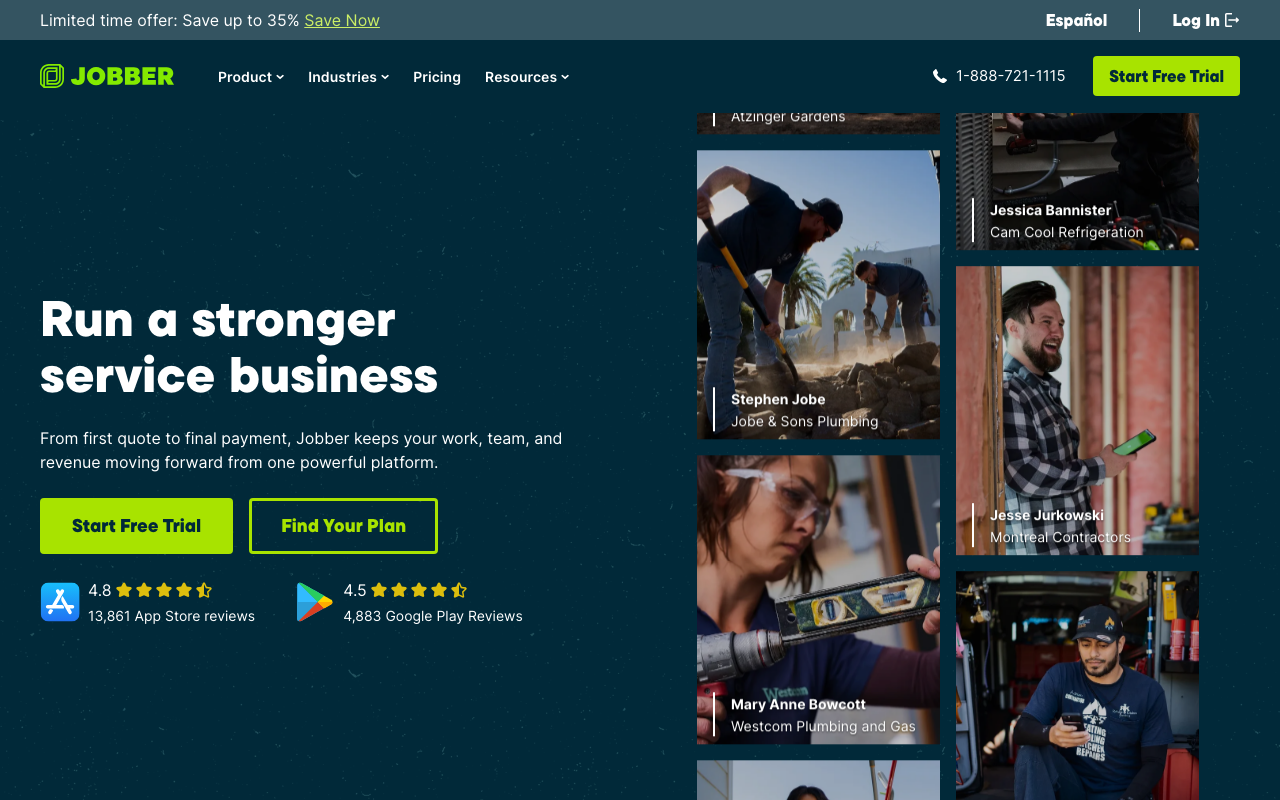 getjobber.com homepage: positioning as "run your business, not your paperwork." Free 14-day trial, no credit card required.
Unit Economics
| Metric | Value | Source |
|---|---|---|
| ARR (2024) | $167.5M | GetLatka |
| Revenue growth (2023-2024) | ~17% YoY | GetLatka |
| Revenue growth (2022-2023) | ~50% YoY | Sacra |
| Average ACV | $1,700 | GetLatka |
| Active users | 250,000+ | Contrary Research |
| Households served | 27M per year | PR Newswire |
| Platform transaction volume | $13B/year | Contrary Research |
| Processing fee | 2.9% + $0.30 | getjobber.com/pricing |
| Employees | ~671 | GetLatka |
| Revenue per employee | ~$250K | calculated |
| Total funding raised | $183.5M | TechCrunch |
Note the gap between 50% growth (2022-2023) and 17% (2023-2024). This isn't slowdown -- it's a deliberate shift from "flood the market" to "monetize the base": online payments, AI add-ons, and upsells into higher-tier plans.
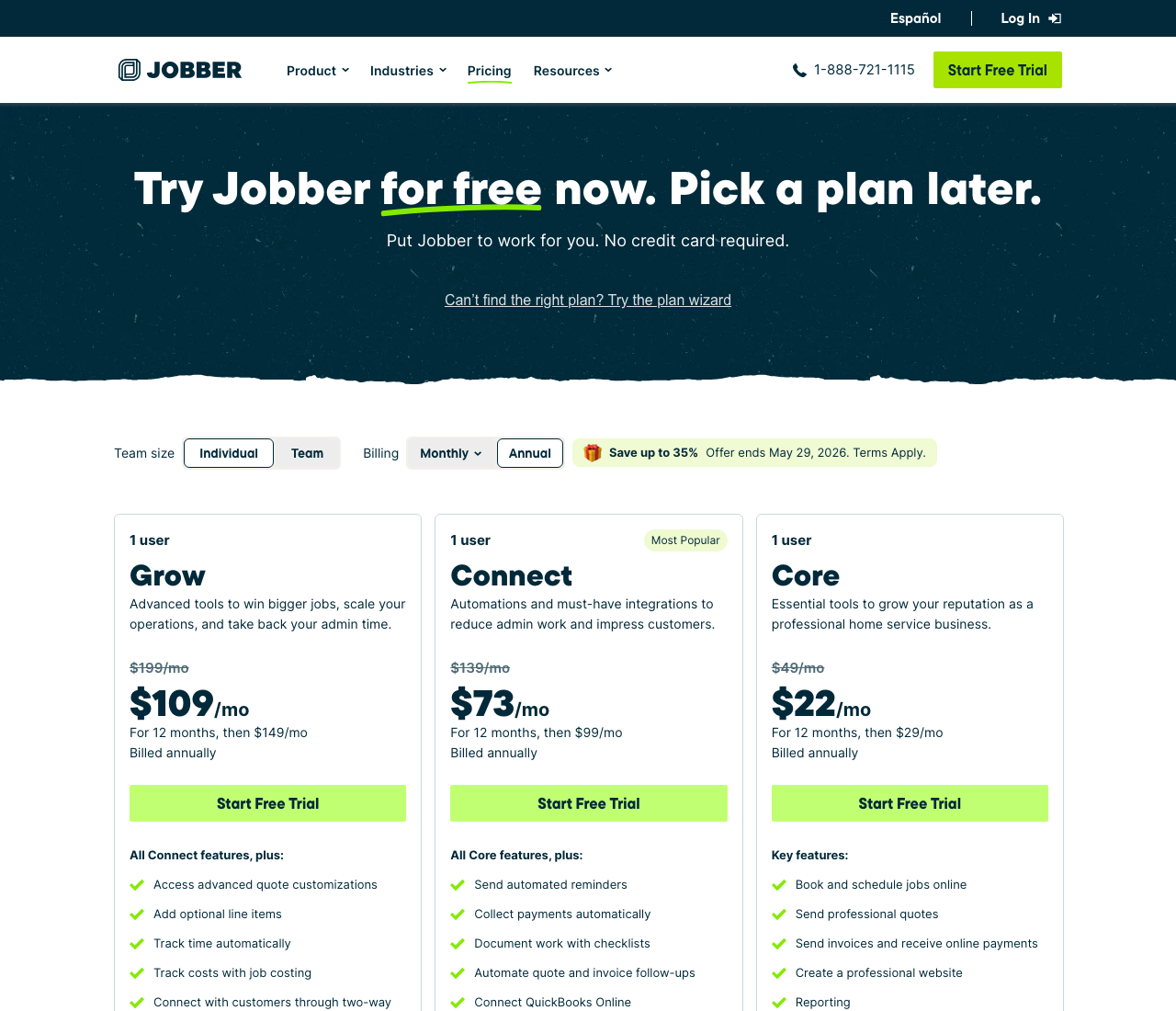 Pricing tiers: from $29/month for solo operators to $529/month (annual) for teams of up to 15. Add-ons -- marketing ($79), AI Receptionist ($99), pipeline ($49) -- are sold on top.
Build Budget for a Clone
| Line item | Estimate |
|---|---|
| MVP (CRM + scheduling + mobile app) | $30-50K |
| Payment integration (Stripe) | $5-10K |
| AI module (voice bot, job classification) | $10-15K |
| Marketing (first 6 months) | $15-25K |
| Total to first 1,000 customers | $60-100K |
Jobber started in 2011 on a budget two freelancers had saved from contract work. Sam Pillar built the first prototype while simultaneously writing software for nonprofits. They didn't raise their seed round of $1.6M until 2015 -- by which point the product was already generating revenue.
The Disruption Point
A typical plumber with two helpers loses 20-30% of revenue to administrative chaos: forgotten invoices, missed calls, double-booked slots. The traditional fix is hiring a dispatcher for $35-45K a year.
Jobber replaces that dispatcher for $99-199 a month. Add the AI Receptionist for another $99 and you've covered the night shift too: the bot picks up at 2am when a homeowner's pipe bursts, collects the details, and queues the job for morning.
The math is simple: $298/month (Connect + AI Receptionist) versus $3,500/month (dispatcher salary + lost jobs from missed calls). Even if the bot converts just one extra job per month, it pays for itself.
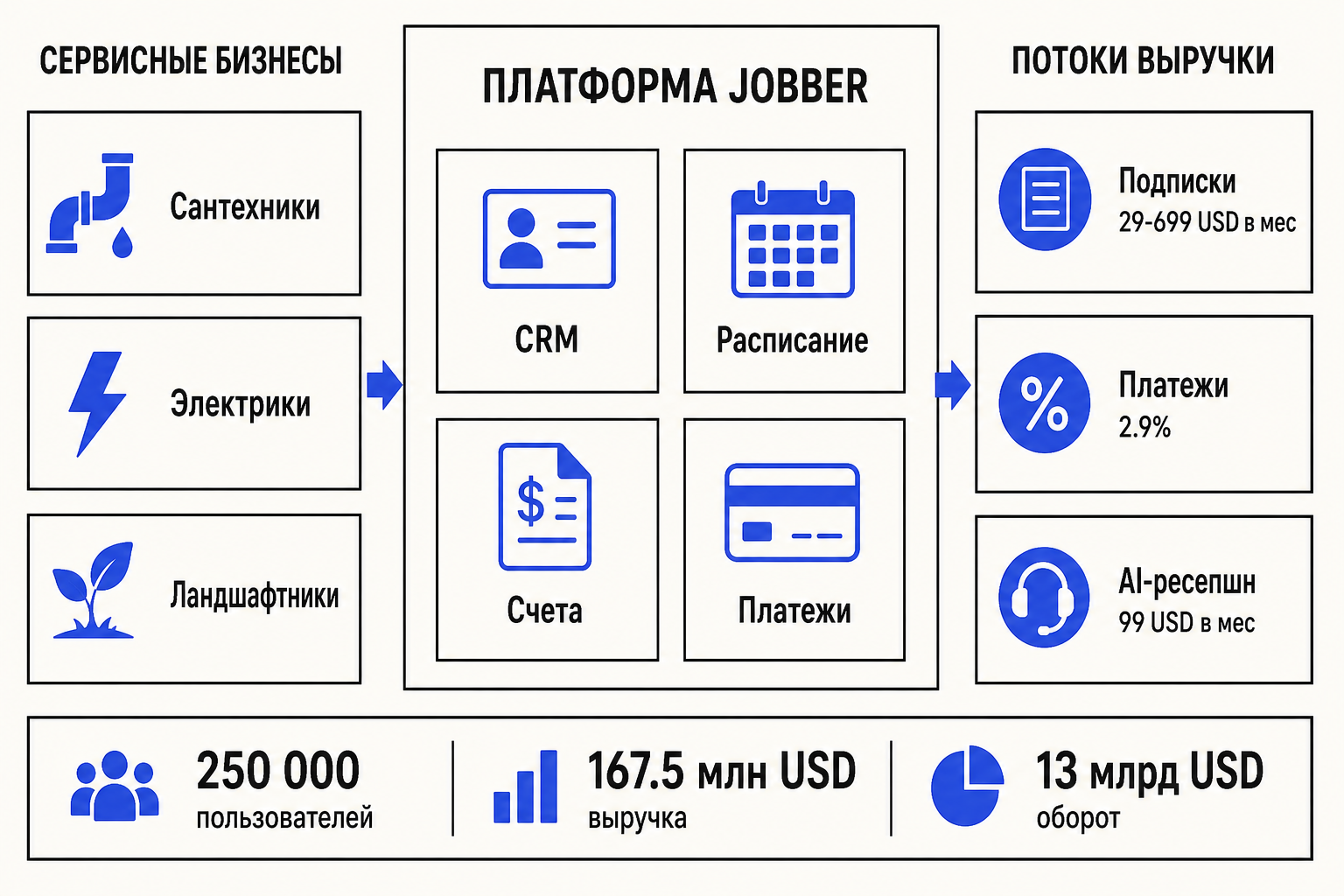 Monetization diagram: service businesses pay a subscription plus a cut of every payment processed. AI add-ons are a third revenue stream.
The Competitive Moat
Jobber competes with ServiceTitan ($1.1B raised, IPO in 2024), Housecall Pro ($175M raised), and a dozen niche players. Jobber's moat comes from positioning: ServiceTitan targets companies with 50+ technicians, while Jobber serves the solo operator and micro-team of up to 15. This is a mass-market segment where the buying decision is made by the owner during a 14-day trial -- no procurement department, no six-month sales cycle. The $13B annual transaction volume creates a data moat: Jobber sees pricing, seasonality, and customer behavior across 60 countries.
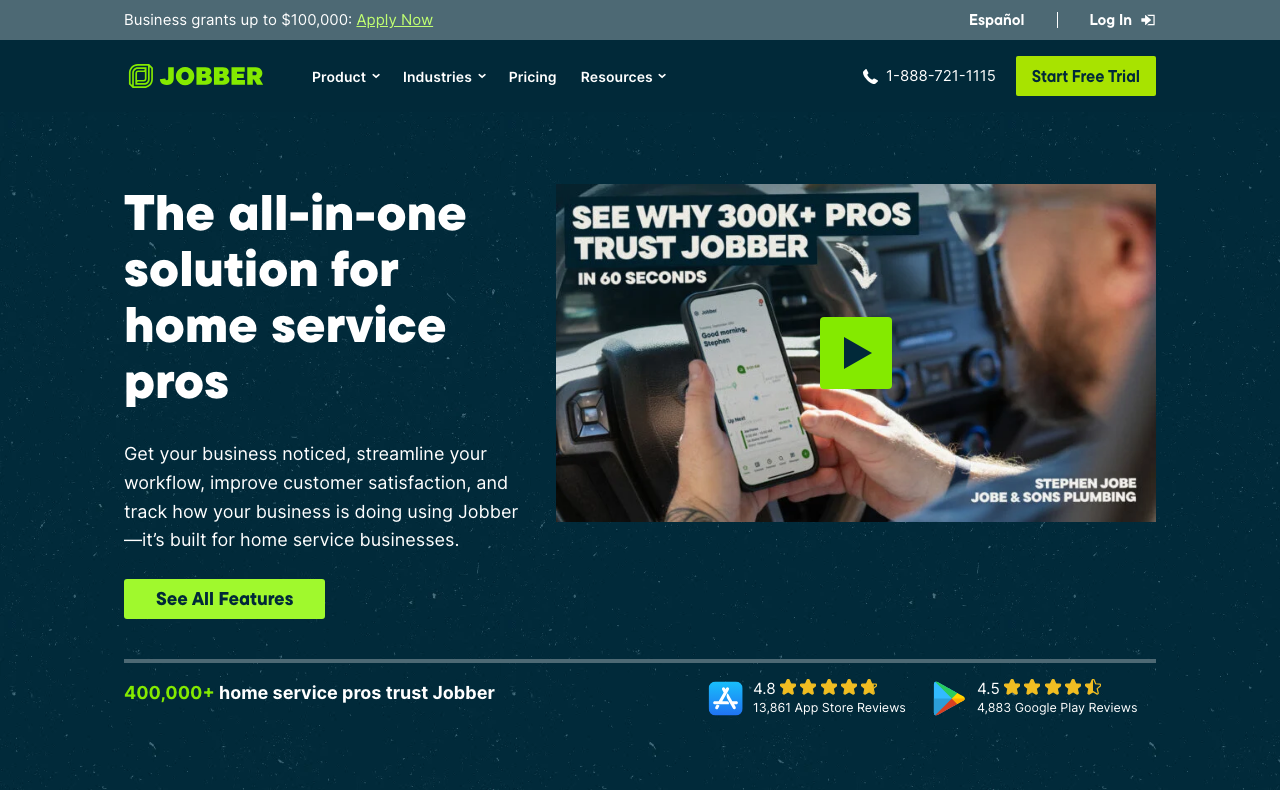 Features page: Jobber highlights that 300,000+ service professionals trust the platform.
How This Works in the US/UK
Local landscape. There is no dominant vertical clone of Jobber in the US or UK small-business segment. The closest players:
- Housecall Pro -- scheduling, estimates, invoicing, and payments for home service pros. Targets slightly larger teams than Jobber.
- ServiceM8 -- popular in the UK and Australia; strong on job management and quoting but lighter on CRM depth.
- Tradify -- UK-focused, trade-specific quoting and job management, lacks native AI features.
- Generic tools like HubSpot and Google Workspace that businesses adapt for field service but without native scheduling or routing.
No competitor fully combines CRM + scheduling + integrated payments + AI receptionist in one product aimed at the 1-15 person team. That gap remains open.
Regulatory considerations. In the US, data privacy requirements vary by state (California CCPA, Virginia VCDPA, etc.). For a UK-based product, UK GDPR applies post-Brexit. Neither framework requires on-shore hosting by default, but enterprise customers in regulated verticals (healthcare, facilities management) may ask for it. No special license is needed to operate a CRM or field service platform.
Tech stack for the US/UK. Payments -- Stripe (processing 2.7-2.9% + $0.30, with built-in ACH for larger invoices). Telephony and voice bot -- Twilio or Vapi. SMS and iMessage notifications -- Twilio Messaging or OpenPhone. Mapping and routing -- Google Maps Platform API. AI -- OpenAI or Anthropic via API.
Acquisition channels. Google Local Services Ads -- direct placement above search results for "plumber near me" queries with a Google Guarantee badge. Yelp for Business -- partner or advertise where tradespeople already have listings. Nextdoor -- neighborhood-level word of mouth and local business ads. Google Ads targeting "CRM for plumbers," "field service software," "invoicing app for contractors." Trade association partnerships and local business groups (PHCC for plumbing/HVAC, NECA for electrical).
Bottom line: fully applicable without structural changes. The model translates directly. The main adaptation is plugging in Stripe instead of a regional acquirer and building Google Maps-based routing instead of a Yandex dependency. SMS/iMessage via Twilio replaces Telegram as the primary channel for communicating with field crews.
Risks
ServiceTitan moving downmarket. Post-IPO, the company has the capital to compete aggressively in the SMB segment that Jobber owns. More engineers, more budget.
Fragmented customer base. The average Jobber customer is a 1-5 person micro-business. Churn is structurally high: small businesses open and close constantly. Consistent new customer acquisition is non-negotiable.
Pricing pressure from horizontal CRMs. HubSpot, Salesforce, and even Google Workspace are adding scheduling and invoicing features. If a horizontal player bundles a "good enough" field service module for free, subscription pressure increases.
AI commoditization. Jobber's own AI Receptionist costs $99/month. Competitors like Bland.ai, Vapi, and dozens of other startups offer generic AI calling for $30-50/month. If a contractor plugs in a third-party bot, that add-on revenue disappears.
Verdict
Jobber proved that a vertical SaaS for "undigitized" trades can scale to $170M ARR without chasing unicorn status -- built on subscriptions, payment processing, and AI add-ons.